Look for changing needs, not a single label
Families often begin researching assisted living because daily life has become harder to manage. A parent may need more help with personal routines, or the person providing assistance may no longer be able to sustain the arrangement. These concerns deserve a conversation, but they do not establish a diagnosis or automatically mean a move is necessary.
Start by describing what you have actually observed. A specific example is more useful than saying someone cannot cope. Ask your parent how the day feels to them and which tasks they would like help with. Their preferences should shape the discussion.
Notice where the current arrangement is stretching
Look at the practical tasks involved in getting through an ordinary day. Are family members providing more help with dressing, bathing, meals, medications, or moving around? Is overnight support becoming difficult to organize? Are appointments or household routines harder to coordinate?
These questions are prompts for discussion, not a scoring system or clinical assessment. A change can have different explanations. Share concerns with an appropriate health professional, particularly when a need is new or worsening, rather than assuming the solution is a particular type of housing.
Write down examples before the conversation
A short record can help families describe the situation consistently. Note the task, the assistance currently provided, and what remains difficult. Include the resident's strengths and routines that are still working well; the purpose is to identify useful support, not to produce a list of failures.
- What help is needed, and at what times of day?
- Who provides that help now, and is the arrangement sustainable?
- What does your parent want to keep doing independently?
- Which concerns need a professional assessment?
Respect privacy when sharing notes. Agree on a primary family contact where possible and avoid circulating detailed medical information to people who do not need it.
Explore more than one support option
Depending on the person's situation, the next step may involve adjusting help at home, discussing community services, or exploring a residential setting. Assisted living and skilled nursing are different arrangements. A community assessment and advice from relevant professionals help clarify what is appropriate.
OneStone Oak offers assisted living in a 16-bedroom residential setting in Stone Oak, San Antonio. Care staff are on duty around the clock. Whether the community can support a particular person should be discussed directly; a website description cannot decide suitability.
Make the setting part of the discussion
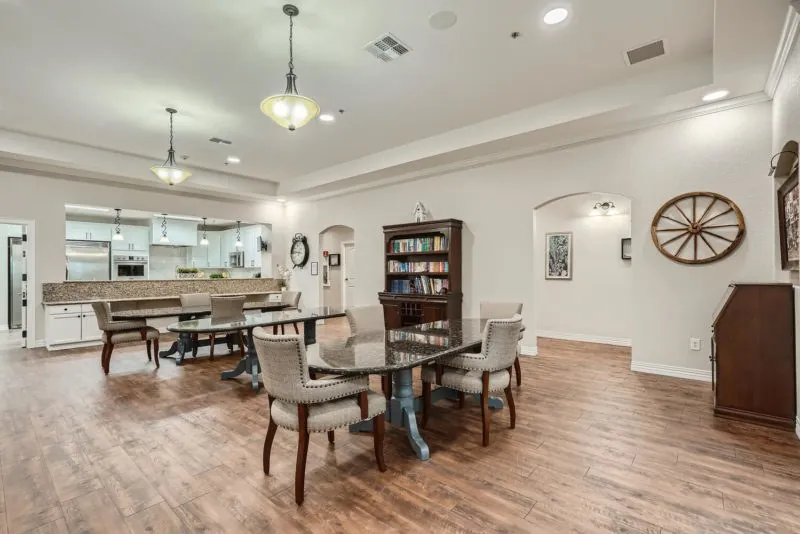
If assisted living is being considered, ask your parent what would help a new place feel comfortable. Talk about privacy, meals, visits, familiar belongings, and the layout. At OneStone Oak, bedrooms are private and bathrooms are communal, so both arrangements should be understood before a decision.
The community was designed with memory care needs in mind. That does not establish a separate memory care certification or make every memory-related need suitable for the setting. Ask about your loved one's actual circumstances during the assessment conversation.
Take one clear next step
You do not need to solve every future decision in a single family meeting. Agree on a next step, such as discussing concerns with a care professional, visiting a community, or arranging an assessment. If there is an immediate medical emergency, seek emergency help rather than waiting for a housing discussion.
For OneStone Oak, call 210-436-8669 to schedule an assessment of physical and medical needs. Pricing follows that assessment, with an all-inclusive quoted rate and no separate level-of-care charges. The community is private pay only and does not accept Medicaid or STAR+PLUS. This guide is general family-planning information, not a medical evaluation.
Signs a parent needs daily support: FAQs
What are common signs a parent needs more help?
Missed medications, skipped meals, difficulty bathing or dressing, falls, and caregiver exhaustion are common reasons families start looking.
How do I start the conversation?
Share specific examples, listen to your parent’s preferences, and explore options together rather than deciding for them.
Is assisted living the only option?
No. Home care, adult day programs and respite stays are alternatives. A short respite stay can be a gentle first step.
Sources and community information
Community details are based on management confirmations and the Texas HHSC license certificate. The resources below provide general background; they do not endorse OneStone Oak.
Explore assisted living at onestone oak →
Talk with us about the support your loved one needs.
Call OneStone Oak at (210) 436-8669 to schedule an assessment of physical and medical needs, request updated pricing, or arrange a private tour.